

AI & Automation · Analysis
Silent Automation: How AI Is Quietly Cutting Jobs and Pay (2026 Data)
· NodJobs
We update this page as new data comes out. Media questions: [email protected]
Key findings
- Seven months beat three years. US employers cited AI for 112,713 announced job cuts from January to July 2026, more than in 2023, 2024 and 2025 combined (71,825). (NodJobs analysis of Challenger, Gray & Christmas data.)
- The pay cut comes before the job cut. Since 2023, real wage growth in highly AI-exposed jobs has trailed less-exposed jobs by 6.7 percentage points, costing about 5.8 million workers roughly $28 billion a year, or about $4,800 each. (Apollo, 2026; per-worker figure is a NodJobs calculation.)
- Workers see it nearly 4× more than bosses admit. 30% of US workers say their team shrank while output held steady or grew. Only 8% of executives say they stopped refilling roles because of AI. (NodJobs analysis of Omni Calculator survey data, 2026.)
- Yet job counts barely move. Yale's Budget Lab found no statistically significant effect of AI on overall US employment as of early 2026.
- The automation runs both ways. 65% of employers say AI rejects some applicants before a human sees them, and 51% of candidates who finished an AI interview never heard back.
- Some companies are quietly walking it back. 32% of US hiring managers whose organizations cut positions after adopting AI say they've added them back.
The short version: AI is replacing tasks faster than it is replacing jobs, and most of that change happens quietly: roles that aren't refilled, teams that shrink, hiring that slows. The layoff headlines show only part of it.
About this analysis: We reviewed more than 20 studies and datasets published between 2025 and 2026. Together they cover more than a billion job ads and tens of thousands of workers and employers. Every number names its source, and the full list with links is at the end. Where studies disagree, we show both sides.
What is "silent automation"?
Silent automation is when a company uses AI to absorb work without announcing that people were replaced. It usually doesn't look like a layoff. It looks like:
- A role that isn't refilled when someone leaves.
- A team that shrinks while its workload stays the same.
- A hiring freeze on entry-level jobs.
- A layoff described as "restructuring" or "efficiency", with AI never mentioned.
Researchers have other names for it, including "ghost downsizing" and "silent firing." The idea is the same: the change is real, but it rarely makes the press release.
Why the silence? "Very few organizations are willing to say, 'We're replacing people with AI,' even when that's effectively what's happening," Christine Inge of Harvard told CNBC. Companies fear backlash from employees, customers and the public.
The admission gap: what workers see vs. what executives say
The clearest sign of silent automation is the gap between what workers say happened and what leaders say they did.
| What was asked | Share saying yes |
|---|---|
| Workers: my team shrank while output stayed the same or grew | 30% |
| Executives: we reduced headcount directly because of AI | 10% |
| Executives: we stopped backfilling roles because of AI | 8% |
| Executives: AI has not affected our hiring decisions | 53% |
Source: Omni Calculator, 2026 (665 US workers and 354 US executives, surveyed on Prolific).
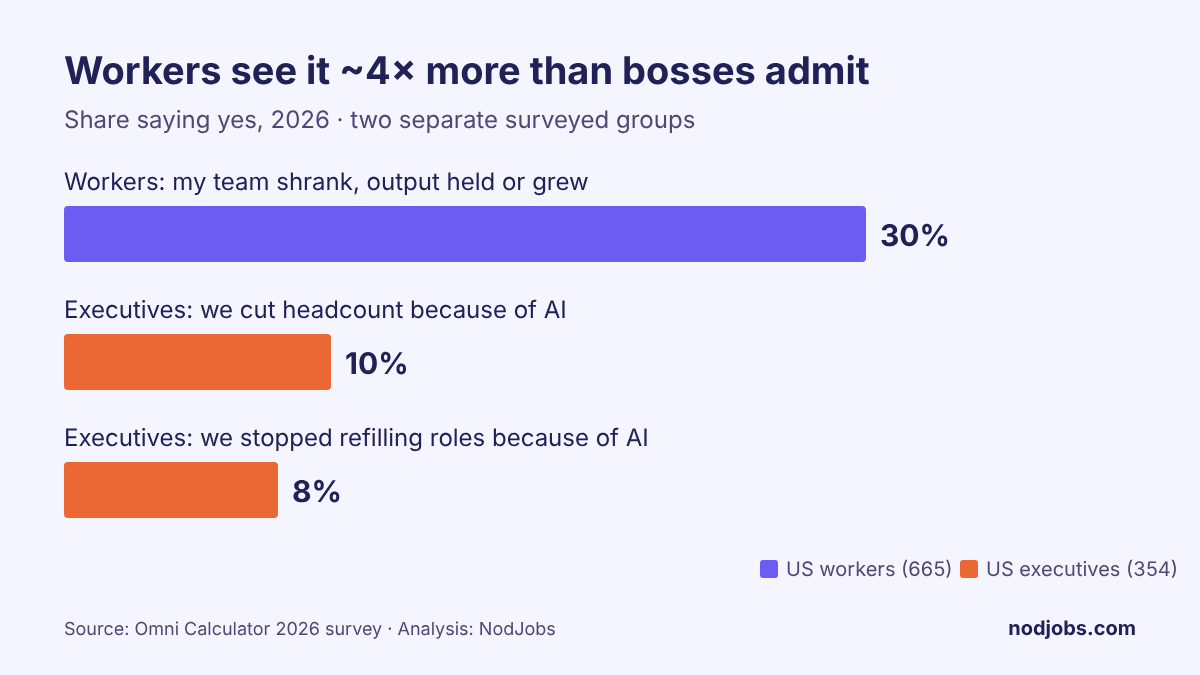
Our read: these are two different groups of people, so the numbers can't be matched one to one. But the direction is hard to ignore. Nearly four times as many workers report shrinking teams as executives admit to not refilling roles. Tech and media show the biggest gap: 38% of workers there report shrinking teams.
The loud part: AI-blamed layoffs
When companies do name AI, the numbers are climbing fast.
- 2023–2025 combined: 71,825 announced US job cuts attributed to AI.
- January–July 2026 alone: 112,713, about 24% of all announced cuts this year.
- July 2026: AI was cited for about one in three announced cuts that month.
- By October 2026: the year's total had reached 121,401, as reported by HRD America.
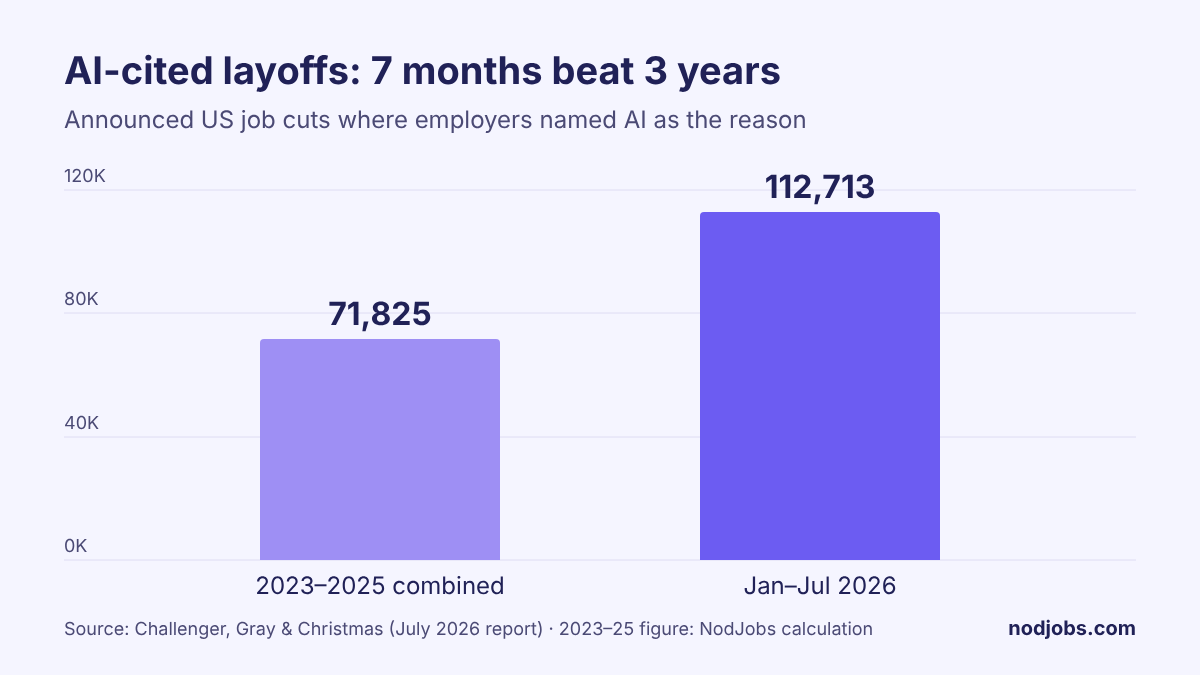
Source: Challenger, Gray & Christmas, July 2026 report (184,538 AI-cited cuts since 2023, 112,713 of them in 2026). The 2023–2025 figure is a NodJobs calculation from those two numbers.
The catch: these counts reflect the reason a company gives, not a verified cause. Challenger itself notes that naming AI in a layoff "can win over investors." This is called AI-washing: blaming AI for cuts made for other reasons, such as cost. So the loud numbers may overstate AI's role in some cases, while silent automation hides it in others.
What the official data says (so far)
If AI were wiping out jobs at scale, government data should show it. So far, it mostly doesn't.
- Yale Budget Lab: no statistically or economically significant effect on employment or wages in AI-exposed jobs as of Q1 2026. The authors add that this "could change quickly."
- Lightcast economist Elena Magrini: "We are not seeing that in the labor data."
- But young workers are the exception. Stanford researchers found a 16% relative drop in employment for workers aged 22–25 in the most AI-exposed jobs since late 2022, while older workers in the same jobs gained. Anthropic's own research found that the monthly job-finding rate for 22- to 25-year-olds in exposed jobs fell about 14% from 2022, a result its authors call tentative.
Why both can be true: silent automation mostly shows up as hiring that doesn't happen. That is hard to see in unemployment figures, because the people who were never hired don't appear as job losses. It shows up first among new graduates and entry-level applicants.
The government is now tracking it
For the first time, the Bureau of Labor Statistics rates occupations by AI exposure. On August 27, 2026, alongside its 10-year job outlook, BLS placed 831 occupations into four tiers, from low to very high. About 206 land in the very high tier, including customer service representatives and web developers. (BLS; tier count via TechInformed.)
BLS is careful to say exposure is not a forecast of job losses. But its own 2025–35 projections show where routine work is shrinking fastest:
| Occupation | Projected change, 2025–35 | Median pay (2025) |
|---|---|---|
| Word processors and typists | −34.4% | $49,280 |
| Switchboard operators | −26.0% | $38,630 |
| Data entry keyers | −25.5% | $41,340 |
| Telemarketers | −21.4% | $35,450 |
| Order clerks | −17.5% | $46,170 |
| Payroll and timekeeping clerks | −15.9% | $58,260 |
| File clerks | −15.8% | $43,600 |
Source: BLS, Fastest declining occupations, 2025–35. BLS does not attribute these declines to AI alone.
Our read: 10 of the 30 fastest-shrinking occupations on BLS's list are routine office, data and phone jobs, the same kinds of tasks AI tools are already doing. All of them pay under $60,000. (NodJobs analysis of BLS data.)
Which tasks AI is already doing
Anthropic measured which jobs AI is actually being used for in practice, not just which jobs it could do in theory. The most exposed occupations:
| Occupation | Observed AI exposure | Median pay | Jobs by 2035 |
|---|---|---|---|
| Computer programmers | 75% | $100,390 | −7% |
| Customer service representatives | 70% | $44,770 | −5% |
| Data entry keyers | 67% | $41,340 | −26% |
| Medical records specialists | 67% | $51,140 | +8% |
| Market research analysts | 65% | $78,760 | +7% |
| All US jobs | — | $50,980 | +3.5% |
Sources: Anthropic, "Labor Market Impacts of AI," March 2026. "Observed exposure" is roughly the share of a job's task workload where AI use is already observed (figures as reported by Euronews). BLS median pay May 2025 and 2025–35 projections.
Our read: high exposure doesn't always mean fewer jobs. Data entry and programming are shrinking, but medical records and market research are still projected to grow. The difference seems to be whether AI replaces the work or helps people do more of it. (NodJobs analysis.)
Two more signals point the same way:
- When businesses use Anthropic's Claude through its API, about three-quarters of the use is full automation of a task, not assistance. Office and admin tasks rose to 13% of that use. (Anthropic Economic Index, January 2026.)
- The government projects office and administrative support jobs to shrink by 752,100 by 2035, the largest decline of any group. (BLS Employment Projections.)
The silent pay cut
Silent automation can show up in paychecks before it shows up in job counts.
- Slower raises in exposed jobs. Apollo economists compared 11 highly AI-exposed occupations, including computer programmers, customer service reps and financial analysts, with less-exposed jobs. After 2023, real wage growth in the exposed group was 6.7 percentage points lower. Lower earners were hit hardest. (Apollo, 2026, using Labor Department wage data.)
- About $28 billion a year in lost pay, spread across roughly 5.8 million workers, or 3.7% of the US workforce. (Apollo.) That works out to roughly $4,800 per worker per year on average. (NodJobs calculation from Apollo's figures; a rough average, not a measured pay cut for any individual.)
- The caveat: part of that gap may come from pay rising in trades such as electricians and construction, boosted by data center building. And Yale's Budget Lab, using a different method, found no significant wage effect as of early 2026. Both studies are early.
At the same time, AI skills are paying off for the people who have them:
| Signal | Number | Source |
|---|---|---|
| Extra pay advertised when a job ad asks for at least one AI skill, vs. similar jobs without it | +28%, about $18,000 more per year | Lightcast, 1.3B+ job postings (July 2025) |
| Premium for ads requiring two or more AI skills | up to +43% | Lightcast |
| Average wage premium for AI-skilled workers | +62% | PwC 2026, 1B+ job ads |
The catch: most of that premium isn't reaching base pay. Employers are routing it through bonuses and performance pay, while more than 63% of employees say their pay is tied strictly to job titles and pay bands. (Randstad, via HRD America, October 2026.)
Our read: pay is splitting into two tracks. Routine roles that AI can absorb are seeing slower raises, while roles that combine AI with job skills command a premium, often paid as bonus rather than salary.
Workers are hiding it too
Silent automation isn't only a company habit. Workers are quiet about AI as well:
- 32% of workers who use AI keep it from their employer. 30% say they fear their job could be cut. (Ivanti, 6,000+ office workers, May 2025.)
- 35% of knowledge workers say they've withheld knowledge because they feared being replaced by AI. (Adaptavist, 4,000 workers in the US, UK, Germany and Canada, 2026.)
- Meanwhile, AI use keeps rising: 52% of US employees now use AI at work at least occasionally, and 15% use it daily, up from 4% in 2023. (Gallup, May 2026.)
Silent automation in hiring
If you're applying for jobs, you've probably met silent automation already.
- 73% of employers use AI in hiring, and 65% say AI rejects some applicants before a human reviews them. (MyPerfectResume, 1,000 US hiring decision-makers, March 2026.)
- 63% of job seekers have been interviewed by AI, and 70% were never clearly told up front that AI would evaluate them. (Greenhouse, 1,200 US job seekers, May 2026.)
- Of candidates who completed an AI interview, 51% never heard back. (Greenhouse.)
- Only 8% of job seekers say AI makes hiring fairer. (Greenhouse, November 2025.)
The quiet reversal
Not every bet on AI is paying off, and companies are just as quiet about undoing them.
- 55% of leaders who made people redundant because of AI say it was the wrong decision. (Orgvue, 1,163 senior leaders, 2025.)
- 32% of US hiring managers whose organizations cut positions after adopting AI say they have since added them back. (Robert Half, 2026.)
Where AI is creating jobs
The same shift is also creating demand:
- Jobs requiring AI skills grew 69%, compared with 9% for the job market overall. (PwC 2026 Global AI Jobs Barometer, 1B+ job ads.)
- AI engineer is the fastest-growing job title in the US. (LinkedIn Jobs on the Rise 2026.) We looked at where AI roles are hiring beyond engineering in our earlier analysis.
- AI-related job postings climbed to 5.9% of all US postings in June 2026, well past their 2022 peak of 3.3%. (Indeed Hiring Lab.)
- It isn't only tech: AI mentions in marketing job ads rose from 8.4% to 14.9% in 2025, and in HR from 4.4% to 8.8%. (Indeed Hiring Lab.)
Even tech leaders are asking what comes next
In April 2026, Elon Musk said government checks, which he calls a "universal high income," would be the best way to deal with AI-driven job losses. Critics, including writers at Reason, argue the idea is costly and premature while job data shows no broad AI-driven decline. The debate itself is a signal: people who build AI are openly planning for a world with less paid work, even while most companies stay quiet about their own plans.
What this means if you're looking for a job
- Watch for fewer openings, not just layoffs. In exposed fields like customer service, data entry and junior coding, the main risk is roles that never get posted.
- Learn to use AI in your own field. The premium goes to people who combine AI with job skills, not only to engineers. Job ads asking for even one AI skill advertise about $18,000 more per year than similar jobs that don't.
- Negotiate the whole package. AI-skill premiums often come as bonuses, not base salary, so ask how variable pay is set.
- Ask whether AI will evaluate you. 46% of candidates want the option of a human interview. In New York City and Illinois, employers already face rules on AI in hiring.
- Apply on the company's own site. You reach the real opening, and you avoid reposted or fake listings. Browse jobs straight from the companies hiring, or see AI and automation jobs hiring now.
- Follow up with a person. If an AI system screened you, a short note to a recruiter can get you a human look.
What to watch next
- Layoff counts are only part of the story. Ask about refill rates, team size vs. output, and entry-level hiring.
- Treat "AI" in layoff announcements with care. It can be overstated (AI-washing) or left out (silent automation).
- Watch young workers first. That is where every study that finds an effect finds it.
- Look at raises, not just headcount. Pay growth may be the earliest signal.
- The public is already worried. 71% of Americans expect AI to mean fewer jobs. (Pew Research Center, June 2026.)
How to cite this
NodJobs, "Silent Automation: How AI Is Quietly Cutting Jobs and Pay," November 2026, https://nodjobs.com/blog/silent-automation-ai-jobs-2026
You're welcome to use any chart or table with a link to this page. To embed a chart, copy this code:
<a href="https://nodjobs.com/blog/silent-automation-ai-jobs-2026"><img src="https://nodjobs.com/charts/ai-layoffs.png" alt="AI-cited US layoffs: Jan–Jul 2026 vs. 2023–2025 combined. Source: NodJobs analysis of Challenger data." width="1200" height="675"></a>FAQ
Is AI taking jobs in 2026?
AI is taking over tasks quickly, and companies cited it for more US job cuts in the first seven months of 2026 than in the previous three years combined. But official data shows no broad drop in employment yet. The clearest effect is slower hiring of young and entry-level workers.
What is silent automation?
When a company uses AI to absorb work without announcing that jobs were cut: roles that aren't refilled, shrinking teams, or layoffs described as "restructuring."
Which jobs are most affected?
By observed AI use: computer programmers, customer service representatives, data entry keyers, medical records specialists, and market research and marketing specialists.
Are companies rehiring after AI layoffs?
Some are. 32% of US hiring managers whose organizations cut positions after adopting AI say they've added them back (Robert Half, 2026).
Sources
- Challenger, Gray & Christmas, July 2026 job cuts report
- HRD America: AI-cited cuts through October 2026 and Lightcast comment
- Apollo: AI's impact on the US labor market (via Axios)
- Omni Calculator: ghost downsizing survey 2026
- CNBC: AI's role in layoffs may be bigger than companies say
- Yale Budget Lab: what we know about AI and the labor market
- Stanford Digital Economy Lab: Canaries in the Coal Mine
- Anthropic: Labor market impacts of AI
- Euronews: the most AI-exposed jobs
- Anthropic Economic Index, January 2026
- BLS: AI exposure categories
- BLS: fastest declining occupations, 2025–35
- BLS: occupations with the largest job declines
- BLS Occupational Outlook: computer programmers
- BLS Occupational Outlook: medical records specialists
- BLS Occupational Outlook: market research analysts
- BLS Employment Projections
- TechInformed: BLS very-high AI exposure tier
- Lightcast: Beyond the Buzz
- HRD America: AI skills premium and pay bands (Randstad)
- PwC 2026 Global AI Jobs Barometer
- Ivanti: employees keeping AI use a secret
- Black Enterprise: employees withholding knowledge (Adaptavist)
- Gallup: AI use at work
- MyPerfectResume: AI in hiring
- Greenhouse: 2026 candidate AI interview report
- Greenhouse: AI trust crisis in hiring
- Orgvue: AI redundancy decisions
- Robert Half: navigating AI adoption
- Dice: LinkedIn Jobs on the Rise 2026
- Indeed Hiring Lab: June 2026 labor market snapshot
- Indeed Hiring Lab: jobs mentioning AI are growing
- Pew Research Center: Americans wary of AI and jobs
- Fox Business: Musk backs a universal high income
- Reason: a critique of the universal high income idea
Found this useful? Share it with someone who's job hunting.
How we counted: We reviewed more than 20 studies and datasets published from January 2025 to November 2026, from government agencies (BLS), universities (Stanford, Yale), research and polling organizations (Gallup, Pew), AI developers (Anthropic) and industry and financial sources (Challenger, PwC, Lightcast, Randstad, Apollo, Indeed, LinkedIn, Greenhouse, Robert Half, Orgvue, Omni Calculator, MyPerfectResume, Ivanti, Adaptavist). We label industry surveys as such and give sample sizes where the source publishes them. "NodJobs analysis" means a calculation we made from published figures, such as AI-cited layoffs in 2023–2025 or average lost pay per worker. We do not combine figures from different surveys into a single number.